As healthcare continues moving toward broader interoperability, the conversation is beginning to shift.
This week, CMS’s “Kill the Clipboard” initiative again drew attention to one of the industry’s most visible pain points: the administrative friction created by paper intake forms, fragmented records, and disconnected systems. CMS has positioned the effort around digital check-in and patient-controlled data sharing, part of a wider push toward a more connected health technology ecosystem.
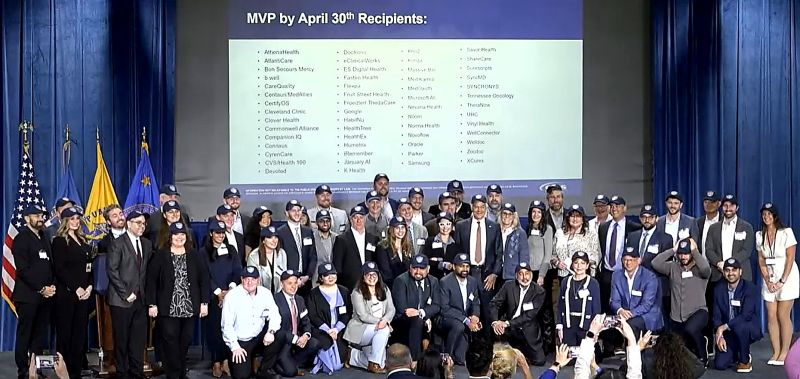 Companies supporting CMS's Kill the Clipboard initiative attend an event hosted by the agency on April 9, 2026.
That reflects clear progress in an area healthcare has struggled with for years. But it also highlights a larger issue now coming into focus across the market.
For much of the past decade, the industry’s interoperability agenda has centered on access. The emphasis has been on making records easier to retrieve, exchange, and share across providers, payers, and digital health platforms. That remains a significant priority, particularly as patients and care teams continue to encounter incomplete histories and duplicative administrative workflows.
As those access layers improve, however, attention is increasingly moving to a more difficult question: what happens after the data is retrieved?
That question is becoming more important as providers face growing volumes of clinical information that may be technically accessible but still difficult to use in day-to-day care. In practice, more data does not necessarily mean better decision-making. In many cases, it can simply create additional review burden for clinicians and staff.
That dynamic is helping define a new competitive focus across healthcare technology. Increasingly, the differentiation is not just in moving data between systems, but in making that data usable once it arrives.
Companies such as xCures are positioning around that next layer. xCures, which is an early MVP recipient of CMS’s “Kill the Clipboard” initiative, is focused on structuring fragmented medical data into formats intended to support search, workflow integration, and clinical use.
The broader market implication is that interoperability may be evolving from a question of access to a question of utility.
That distinction matters for healthcare providers operating under growing clinical and operational pressure. A record that can be retrieved is not necessarily a record that can be acted on. To be useful in care delivery, information often needs to be normalized, contextualized, and surfaced in a way that supports specific workflows, whether that involves identifying care gaps, supporting quality measures, or informing treatment decisions.
This is also where much of healthcare AI appears to be gaining traction. While consumer-facing tools continue to attract attention, some of the more consequential opportunities may lie in infrastructure-level systems that make clinical data more structured, more trustworthy, and more relevant at the point of care.
CMS’s interoperability push does not resolve that challenge on its own. But it does reinforce the direction the industry is taking. If the first phase of healthcare digitization was about freeing data from silos, the next phase may be about making that data operationally meaningful.
In that sense, the next frontier is not simply digital access. It is turning healthcare information into actionable intelligence.