For most owners of small and midsize companies, the first serious estimate of what the business is worth comes from someone who wants to buy it. A letter of intent arrives or a private equity firm calls, and an owner who has spent decades running the company has a few weeks to learn how buyers will price it.
Dealade, which launched publicly in August, is built for the long stretch before that call. Its platform lets owners see their company the way a buyer would, work on the issues that hold its value down and track that value over time, whether or not a sale is anywhere on the calendar.
The company is led by Scott Yenor, a 25-year-old chief executive who came out of MidCap Advisors, the lower-middle-market investment bank whose partners back Dealade. He spent those years watching owners arrive at the deal table after the result was largely set.
“We added real value in how we positioned a business and ran the process,” Yenor said. “But positioning has limits. Buyers do their diligence, and the foundational risks in a business show up no matter how well you tell the story.”
The decade before the decision
The market Dealade is going after is large and getting larger. The McKinsey Institute for Economic Mobility estimates that about 6 million small and midsize businesses will face an ownership transition by 2035 as baby boomers retire. More than 1 million of them are viable candidates for a sale, representing as much as $5 trillion in enterprise value.
History suggests many will never get there. Of the roughly 510,000 small and midsize businesses that exited the market in 2022, McKinsey found, 92% closed and 5% were sold.
Preparation also lags well behind intent. More than half of the baby boomer owners surveyed by the Exit Planning Institute said they plan to leave their business within five years, yet only 27% had completed a formal valuation.
Owners do not always get to choose their timing, either. Dealade’s launch announcement describes a set of “D-Risks” that can force a sale before an owner is ready, including disability, divorce, disagreement, disillusion, disruption and the departure of a key executive.
“Owners watch revenue every week, and most of them could tell you last month’s number from memory,” Yenor said. “Very few of them watch the value of the company the same way, even though it is usually the largest asset their family has. The decade before the decision to sell is when that number can still be moved, and for most owners that decade has been empty.”
From analyst to chief executive at 25
Yenor joined MidCap Advisors while finishing his degree at Babson College and started full time the month he graduated. Since 2022 he has served as lead analyst on more than half a billion dollars in lower-middle-market mandates across insurance, industrials, business services and education, working on both the buy side and the sell side. He also built the bank’s AI infrastructure, marketing automations, and customer relationship system.
MidCap has spent more than 40 years in the deal room and closed more than 400 lower-middle-market transactions worth over $10 billion. Dealade grew out of something its bankers kept seeing, which was that owners tended to bring in advisers too late to change the result. Once AI made it possible to deliver that kind of preparation through software at a price a small company could afford, the team started building, and Yenor was named chief executive of the new company.
 Scott Yenor, chief executive of Dealade. Image: Dealade.
“I get asked about my age, and I understand why,” Yenor said. “But I’ve sat with owners who learned what their business was worth too late to change it. Dealade is built for the decade before a sale, and I’m not going anywhere.”
One early sign of demand came before the public launch. At a major accounting industry convention in Nashville earlier this year, advisers were talking about Dealade among themselves, with no one from the company there to pitch it. Owners in this market tend to take their cues from the accountants and advisers they already trust, and Yenor calls that his favorite moment at the company so far.
Inside the platform
Dealade is aimed at founder-led U.S. companies with up to $50 million in revenue. An owner can start by entering the company’s website to get a directional valuation estimate drawn from public information, with no email address required.
From there the work moves into a private workspace. Owners connect their accounting system, beginning with QuickBooks, upload documents and answer a structured set of questions, and the platform returns a view of what the business is worth and where it needs work. Guiding the process is Russell, an AI concierge informed by the patterns of hundreds of closed deals, which anticipates what a transaction will require next and flags the questions buyers are likely to ask.
When an owner wants to talk to a person, the platform connects them to a network of professional service partners that includes accountants, fractional CFOs, marketing agencies and investment banks such as MidCap Advisors. A buyer portal that opened shortly after launch lets private equity groups, family offices, independent sponsors and strategic acquirers set their mandates and receive matching deal flow, while owners decide what is shared and with whom.
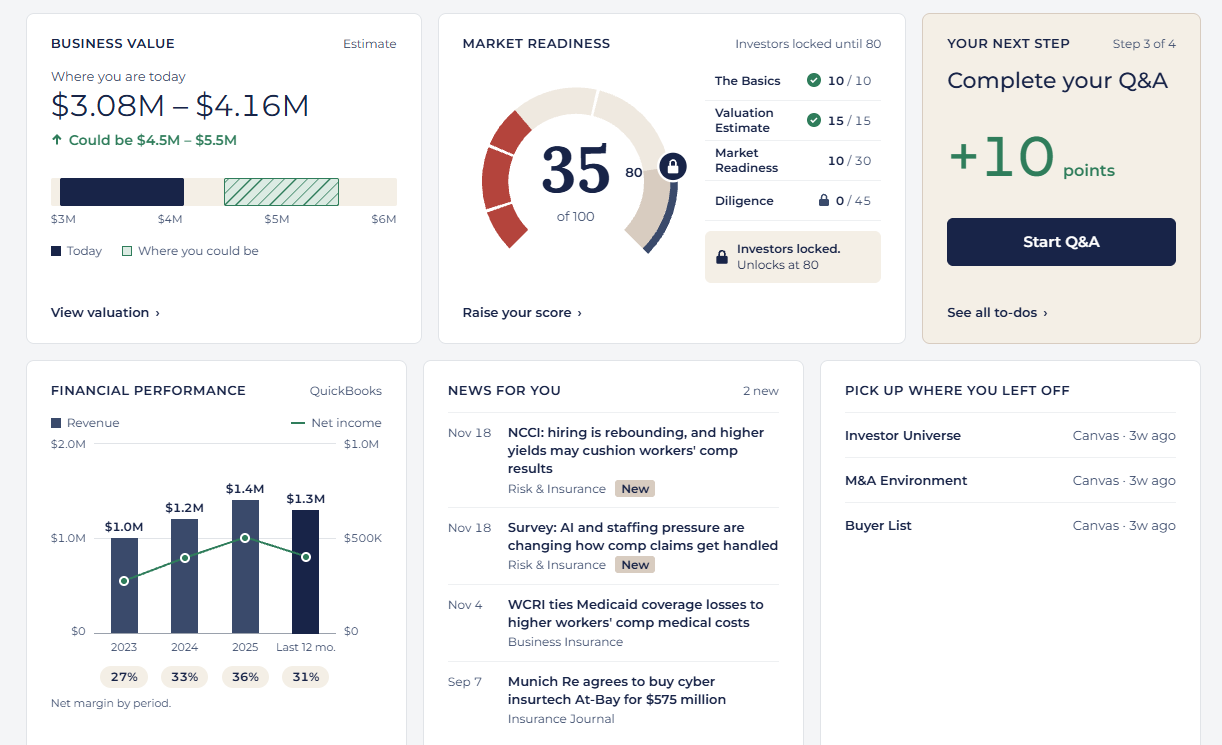 The Dealade owner workspace, shown with sample data, tracks an estimated value range, a market-readiness score and financials pulled from the accounting system. Image: Dealade.
Pricing starts with a free tier. A subscription for business owners costs $349 a month, and a version for full-scale deal teams runs $1,999 a month. The higher tier serves a second group of customers, the M&A advisers who run sale processes for their clients on the platform.
“Plenty of the owners on the platform have no plans to sell in the next five years,” Yenor said. “They want to know what the business is worth and what would make it worth more. If they do decide to sell one day, they will already know the answers to the questions a buyer is going to ask.”
Dealade has not disclosed its funding or revenue. Yenor said that since its public launch in August, its early users include more than 70 institutional investors, more than 25 independent founders and two national investment banks that have adopted it for their own engagements.
Where the data stays
The product asks owners for the most sensitive information they have, and Yenor describes what happens to that information as a founding principle of the company. Dealade says it does not sell or share owner data, does not train on it and will not package it into anonymized data feeds.
The controls are built into the workspace. Data is encrypted at rest and in transit, and owners decide who can see what data and when they can see it. Every view is logged, and buyers receive a deal only when an owner decides it is time.
“An owner’s financials are the most private thing they have,” Yenor said. “If they thought a bank or a buyer could see what they put into Dealade, they would never be candid with it, and the platform would be useless to them. So nothing an owner puts in gets sold, shared or used to train a model.”
The same separation applies to the bank Dealade grew out of. The company operates independently, and MidCap has no visibility into what owners put on the platform.
“MidCap’s experience shaped how we think about the process, and it is one of the partners an owner can call on,” Yenor said. “Dealade is its own company, though, and no bank sees what an owner does here.”
A more demanding buyer
Yenor’s case for urgency rests on what is happening on the other side of the table. Buyers have become more selective, and many now use AI in diligence to work through a target’s contracts and financials faster than a seller’s team can anticipate. AI is also wearing down some of the advantages that once earned companies a premium, a theme he took up in October in an op-ed for The AI Journal titled “AI Is Repricing Your Company.”
He has made a version of the same argument to individual industries. Writing in InsuranceNewsNet that same month, he argued that falling premium rates expose how much of an insurance agency’s growth came from price increases alone, and that owners are better off learning that before an acquirer does. He was also quoted in a recent Carta analysis of search funds, the single-acquisition vehicles gaining ground as the number of new private equity funds heads toward a decade low.
“Buyers are showing up to diligence with tools that can read every contract and every ledger in a matter of days,” Yenor said. “The owner across the table deserves the same quality of preparation, and until recently there was no affordable way to get it.”
Dealade is entering a crowded field, as a growing number of startups pitch AI tools to owners and acquirers ahead of the boomer handoff, and Yenor acknowledges that many owners are skeptical of them. His argument is that most of those tools were built from the outside in, while Dealade was built from inside the deal room. It was shaped by more than 40 years of experience and over 400 closed deals, and it comes with relationships with the accountants, CFOs and bankers owners already trust.
“Software can be copied,” Yenor said. “Forty years in the deal room can’t.”
What comes next
The next major addition is a more robust valuation engine. It will draw on the traditional methods bankers use to value a company, present the result in terms an owner can follow and put a dollar figure on each improvement an owner could make. Beyond that, the company plans to connect more accounting systems, expand what Russell can do, grow its buyer portal and keep refining the platform based on what its users tell it.
Education is part of the plan, too. The company has published a free 42-page playbook, “10 Things That Make or Break Your Business’s Value,” and a library of interviews with founders who have been through an exit. Further out, Yenor is exploring a version of the platform for students, built around case studies and a live learning environment. As AI takes over the entry-level analyst work that has long trained young bankers, he sees it as a new way to learn the trade.
“An owner should know what the company is worth before anyone else tells them,” Yenor said. “If we do our job, the day a buyer calls will be the least stressful day of the whole process, because the owner will have been ready for years.”
The open question is whether owners will adopt a tool for a decision many would rather put off. Yenor is betting that the coming wave of ownership transfers will make the cost of waiting plain, and that a generation of owners will decide to set the terms of their exit rather than have those terms set for them.